Posts

The nightmare plant

Image
For many years we have had a plant of sacred bamboo Nandina domestica growing by the wall outside our back door. In Japan, if you have a nightmare, the custom is to go and tell the sacred bamboo plant so that it will take away any residual difficulties from the dream.  Perhaps that is why this plant has strangely anguished-looking foliage.

Psychogeog round Bevendean,Brighton, UK

Image
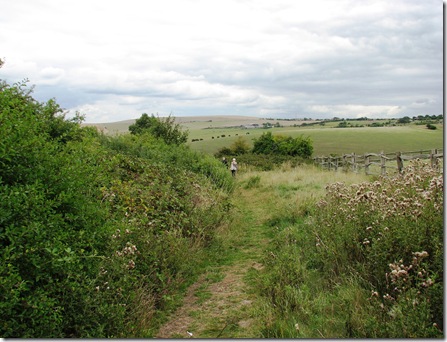
Yesterday in the August rain Jeremy Linden and I went to Meadowview in Bevendean on the eastern outskirts of the city of Brighton and, starting from map ref TQ33220608, we walked eastwards along a corridor of the Bevendean Down Local Nature Reserve (below) to the Race Hill footpath. Here we turned south and then up the hill past the race horses to the summit with its magnificent views across Brighton and the racecourse to the sea.  Close to the top of Race Hill on an unmade cul-de-sac is an isolated row of terrace houses called Bellevue Cottages built in the mid- to late 19th century. On the side wall of the blue cottage the owner had painted some impressive zodiacal devices.   After Bellevue we made the long trek down Bear Road with the cemetery wall on the right and open fields on the left, but much traffic in between.  At Bevendean Road we turned north and explored the Tenantry Estate - all new houses and turfed grassland built on the former Bevendean Hospital a...

Stinging nettles through faded curtains

Image
The strong July sun falls from the east on to our large room curtains silhouetting the nettles in the border outside.  The curtains are faded now and torn or threadbare in places, but they do. The garden is unkempt but some like it that way, especially the stinging nettles.  All I have time for now is to keep a path open to the far end and back by a different route. There are many compensations like this out-of-focus pattern on the old fabric which moves gently as the breeze catches the nettle plants. Winter will take the plants away and leave just the worn material and the memory of sunshine.

A trip to Derbyshire

Image
On 17 May 2010 (our son's 35 birthday), I found myself at Chesterfield station in Derbyshire with a little time of my hands. To my surprise I discovered a statue of George Stephenson (supposedly one of our distant relatives) of Rocket fame outside the station entrance. Stephenson died in Chesterfield and is buried in the nearby churchyard at the church with its famous crooked spire. The bronze statue was erected in in 2005 to mark the opening of the new station entrance hall with a man who was so instrumental in the establishment of travel by train. I wandered psychogeographically round the precincts of the station entrance admiring the solid red brick architecture. And the intricacy of the view up Corporation Street from Crow Lane. I also enjoyed the sight and sweetly pungent smell of a flowering dwarf broom hedge (possibly Cytisus x praecox 'Allgold'). Soon though I was speeding through the Derbyshire Dales countryside at its late spring best en rout...

On a Richard Dawkins review

In the Times Literary Supplement for 11 February 2009, Richard Dawkins reviews a book by Professor Jerry Coyne called Why evolution is true published by Oxford University Press.  Dawkins is sufficiently persuasive to have induced me to order a copy, so I might dare to say a bit more after I have read it. While I have been happy since childhood to believe, alongside Professor Coyne, that evolution is true, I often feel that the leaders in the field are suggesting that nothing about the mechanisms of evolution remain unresolved.  It is encouraging therefore to read in a paper by Antónia Monteiro and Ondrej Podlaha (2010) from the Department of Ecology and Evolutionary Biology, Yale University "There is still much to do in order to fully understand how novel complex traits evolve. ....  it is important to continue exploring the full complement of genes that are shared across multiple traits to identify gene clusters that may be behaving as an integrated and context-insensit...

Rural psychogeography

I was recently introduced, by my son Charles, to the realm of psychogeography, something I really should have known about as it has been going on for years and, according to some, has almost exhausted its possibilities.  Usually though it is to do with urban wandering, so the rural dimension is, perhaps, a rare variant. However, urban or rural, it is new and interesting to me.  I won't try and define what it is because it is easy to look up on the Internet, but I have appended below one of many examples of the genre penned by myself without knowing what I was doing. Solvitur ambulando , it is solved by walking, a Latin phrase normally attributed to St Augustine of Hippo.  But quite what is solved by walking I am not sure, though it sounds good. Anyway, here is my rural psychogeographic text (from 2001): 8 July 2001 (A walk from Coleford in the Forest of Dean where I was staying for a couple of days with David and Vicki Thornton. I got up early one Sunday morning and, ...

How have I got into evolution anyway?

How have I got into evolution anyway?  It goes a long way back.  From early childhood I was deeply interested in wildlife and when I was 8 or 9, towards the end of World War II, my mother bought me a book called The Story of Living Things and their Evolution , written and illustrated by Eileen Mayo (1944) who was not a professional biologist. I was enthralled by this book and, turning the pages today, I can remember the pleasure each picture and the accompanying text gave me. The book was scientifically blessed with an introduction by Julian Huxley.  This contains some astonishing remarks.  For example, Huxley writes that Darwin and others "finally dethroned man from his claim to a unique position of Lord of Creation."  (I though that was God!).  Then Huxley rather contradicts himself in the next paragraph by saying that "as a result of studying evolution, we now know not merely that man has evolved from lower animals, but that he is now the sole trustee ...

My almost successful arrival

My almost successful arrival in the land of evolution makes me feel a bit like Uncle Toby on Tristram Shandy and his fascination with fortifications and their technicalities. By following my nose on this I discovered that Michael Nyman, one of the modern composers I like most, had written something called The Nose-List Song as part of a Tristram Shandy opera (still under construction).  This shed no light on evolution, but was good to listen to. Suzan Mazur talks with Vincent Fleury of the differences between French and American (Anglo-Saxon) thinking, particularly as it relates to evolution and morphogenesis/self-organisation.  But what is Chinese, or Indian, or Australian aboriginal thinking going to contribute towards the debate?  In the latter case both animate and inanimate objects are said to have been brought into being by song.  This somehow chimes with the Music of the Spheres, the Musica Universalis of celestial motions, an idea dating back at least t...

A papaya smoothie

There are many recipes for papaya smoothies on the Web, but most call for the seeds to be removed and discarded.  Papaya seeds are edible and add an interesting spicy flavour if used in the smoothie. I made mine by putting the flesh and seeds of one papaya in the tumbler and topping up with white grape juice to the level of the fruit.  Vigorous blending crushed the seeds in this mixture and I passed the smoothie through a fine mesh sieve to get the black seed bits out.  It did not take long, or too much elbow grease to do this, but the result was excellent and unusual.

Pigeon on the Roof

Image
One of the wilder shores of music is represented by this original composition, or improvisation, Pigeon on the Roof . The bird in the picture above is a collared dove on our roof.

The Lachrimae Pavan

Image
Now I am old (69) I seem to live on a musical island. Long ago when music first started to excite me I would spend many hours talking to friends about different composers, players and genres. There was a wonderful world to be explored on expeditions of discovery. Now I rarely encounter anyone who wants to talk about music, or indeed any of the fine arts, though I arguably meet more people than I did of yore. Friends either don't seem interested in music at all or have a taste for popular or commercial material written in the last few decades. I do not dislike their choice, but it seems to me rather limiting. The wonderful landscapes of folk, jazz, classical and so-called world music remain unexplored and unloved. And I now have no one to whom I can say "this is an interesting piece" with the slightest chance that they will listen to it all the way through without starting to talk about the blocked drains or the despicable neighbour. The Internet has, however, revealed a w...

Sussex dumplings

Today I made some traditional Sussex dumplings to go with our lunchtime soup. They are very simple and really rather dull. Make them by mixing plain white flour and some salt to a soft dough with water. Then scrape teaspoonfuls into boiling water using two spoons, or a spoon and knife. Simmer for 45 minutes, drain and add to your soup.

The snail on the crab apple

Image
This reminded me of Roberts frost's lines: For I have had too much Of apple-picking; I am overtired Of the great harvest I myself desired. . .

Sammy's mandala

Image
Something to look at rather than to speak about. Sammy made this 'Tribute to the Moon' in the garden today. "I was just playing" she said. It is on the site of a fire.

Chinese tea

Image
I surveyed a small back garden on a slope facing the sea. There was a bank of grass, a patch of brambles and convolvulus. A late cabbage white flew down the road and back. There were woodlice and garden snails under the stones, even a few sandhoppers far from the shore. A Chinese woman from Beijing brought me a cup of green tea full of cornflowers, rosebuds and assorted leaves.

The Child in the Garden

Image
When to the garden of untroubled thought I came of late, and saw the open door, And wished again to enter, and explore The sweet, wild ways with stainless bloom inwrought, And bowers of innocence with beauty fraught, It seemed some purer voice must speak before I dared to tread that garden loved of yore, That Eden lost unknown and found unsought. Then just within the gate I saw a child, - A stranger-child, yet to my heart most dear, - Who held her hands to me and softly smiled With eyes that knew no shade of sin or fear; "Come in," she said, "and play awhile with me; I am the little child you used to be." Henry Van Dyke [1852-1933] The child is our granddaughter Elly, the place our garden in Sedlescombe on 26 August 2006.

Rain, rooks, viols

French grey rain dimpling olive puddles The anemones and dandelions stay shut on the hedge banks A rook stationed itself on the wire by the top of the telegraph pole while the car carried the slow sound of viols along the wet lane

The Third Branch

The Third Branch, the chequered horse at the stream under the skylark overlayered landscape of dens and denes, gills and gullies woods, copses, shaws and spinneys.

Fire cows

Brazen celandines pinned on the grass where fire cows ruminate on cud dreaming of leaf-rimmed pools pierced by fallen timber. While the cantilevered branch splashes the blue-brown water the weblogs interweave, one modifying another

The dangerous prophet

A prophet may come in the new Dark Ages From the sea-green forest where the leaf waves crash in the branches From the glaucous sea, ribbed and dangerous